AI Amplifies the Value of Human Skill
@admin 8/8/2026 1:25:22 AM
AI Isn’t Just Changing Jobs. It’s Raising the Value of Human Skill
AI is not simply automating knowledge work. It is changing what organizations hire for, what they reward, and how careers develop. For years, the debate about artificial intelligence and employment was framed as a contest: humans versus machines. As of mid-2026, that framing looks increasingly incomplete. AI is certainly reducing demand for some structured and repetitive work. But it is also increasing demand for people who can use AI to solve harder problems, exercise judgment, communicate across disciplines, and convert faster execution into business value. The emerging divide is therefore not simply between “AI jobs” and “non-AI jobs.” It is between work that AI can largely automate and work in which AI acts as a force multiplier for human expertise. That distinction is already visible in hiring, wages, productivity, organizational structures, and entry-level career paths. The central workforce question is changing from “Which jobs will AI replace?” to “Which combinations of human and machine capability will create the most value?”
Contact us to learn more about which AI Certificate may help to advance your career
1. AI is compressing the traditional career ladder
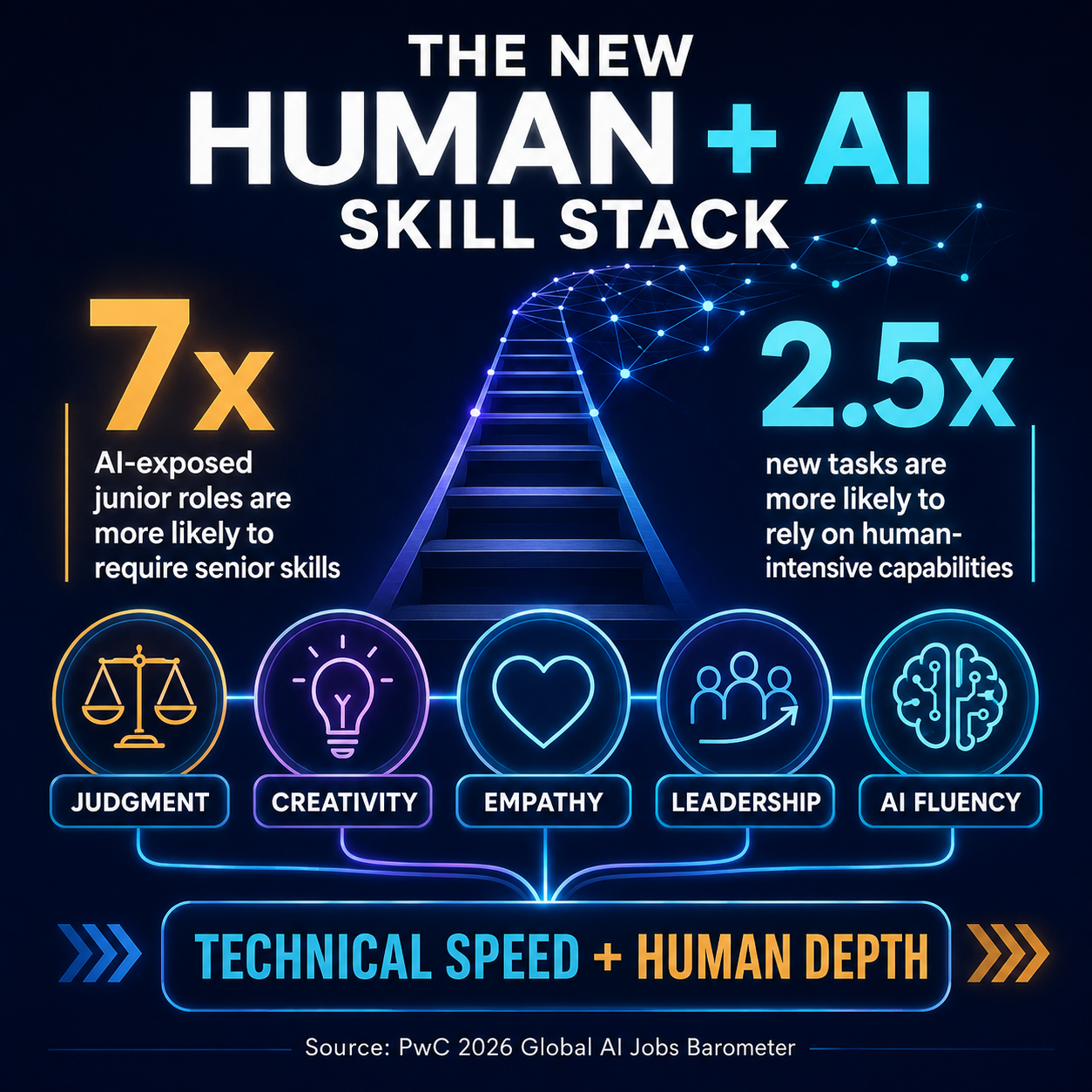
Many professional careers have historically begun with routine but instructive work: gathering data, preparing first drafts, reconciling records, conducting basic research, creating reports, or producing an initial analysis for senior review. These tasks were not always glamorous, but they functioned as an apprenticeship. Junior employees learned the business by doing the foundational work. AI can now perform a growing share of that execution. The consequence is not necessarily the disappearance of every junior role. It is the “seniorization” of entry-level work. PwC’s 2026 Global AI Jobs Barometer analyzed more than one billion job advertisements across 27 countries and territories, including 2.4 million entry-level roles in the United States. It found that entry-level jobs with the greatest AI exposure were seven times more likely than the least-exposed junior jobs to require skills traditionally associated with senior employees, including leadership, creativity, judgment, and face-to-face interaction. Job openings for these “seniorized” entry-level roles grew 35% from 2019, while other entry-level roles declined 10%. (PwC, 2026) This creates both an opportunity and a structural risk. The opportunity is a kind of rookie advantage. An early-career professional who is highly fluent with AI, learns quickly, understands the business domain, and can make sound decisions may assume meaningful responsibility much earlier than previous generations did. AI can give a capable newcomer access to analytical and production capacity that once required a larger team. The risk is that organizations may remove the very work through which judgment was traditionally developed, then expect new hires to arrive with judgment already formed. A career ladder cannot simply lose its lower rungs without an alternative system for mentoring, practice, feedback, and progressive responsibility. The implication for employers is clear: if AI changes the apprenticeship, companies must redesign the apprenticeship. Structured simulations, supervised AI-assisted projects, rotational assignments, mentoring, and explicit decision reviews will become more important—not less.
2. The labour market is splitting between automation and augmentation
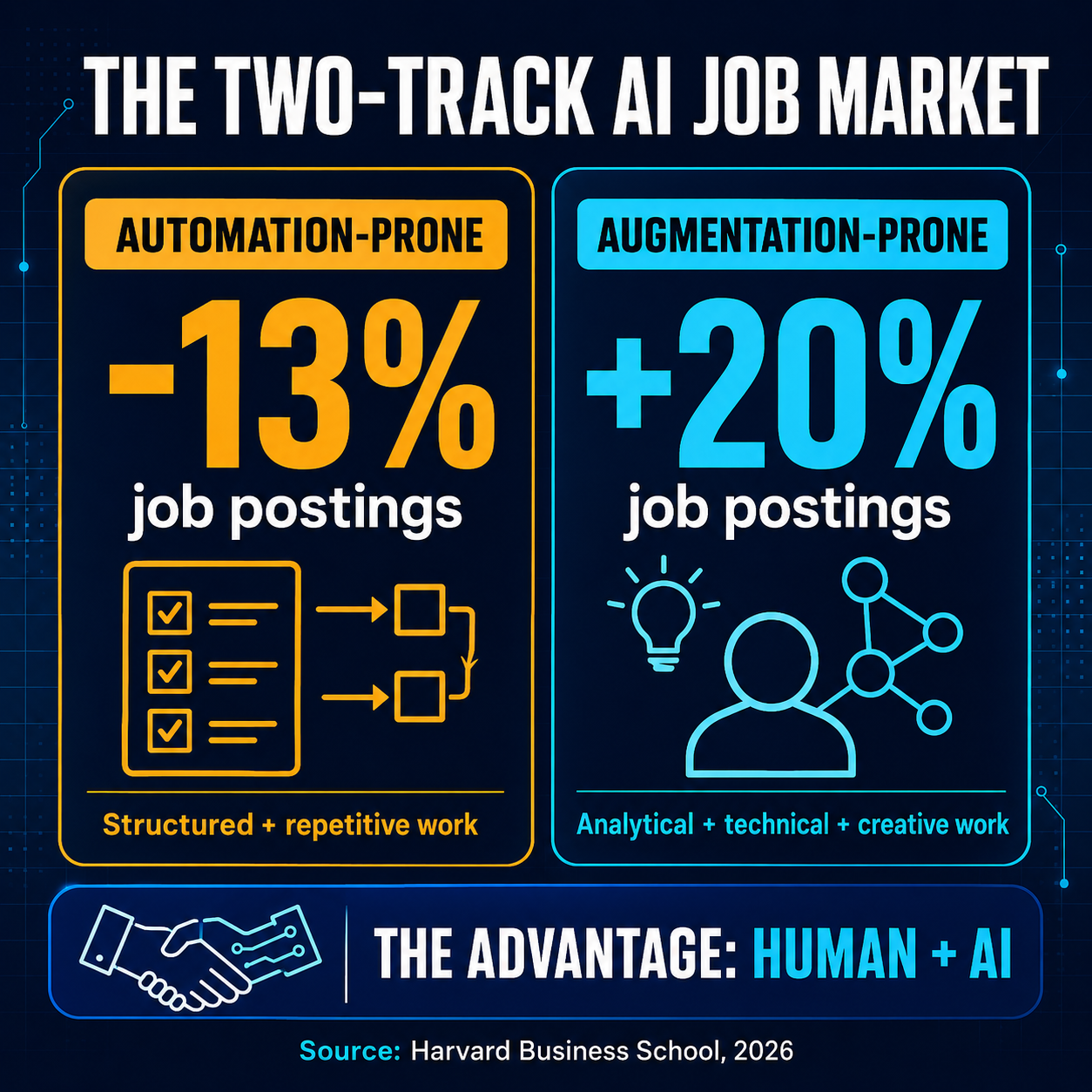
The strongest evidence does not support a single, universal story in which AI either destroys jobs or creates them. It points to a two-track labour market. Research featured by Harvard Business School examined nearly all US job postings from 2019 through March 2025. Following ChatGPT’s public launch in November 2022, postings for occupations dominated by structured and repetitive tasks fell 13%. Over the same period, demand for occupations involving more analytical, technical, or creative work—where AI is more likely to augment a worker—grew 20%. The researchers also found that automation-prone roles listed 7% fewer skills, while augmentation-oriented roles increasingly requested AI-related capabilities. (Harvard Business School Working Knowledge, 2026) PwC describes a related divide between roles that are professionalized by AI and those that are democratized by it. In professionalized roles, AI handles more basic work while the human concentrates on expertise, judgment, relationships, and complex decisions. In democratized roles, AI makes the occupation easier for a less-specialized worker to perform. PwC reports that professionalized roles are experiencing twice the job growth and 42% faster wage growth than democratized roles. (PwC, 2026) This helps explain why AI adoption can coexist with headcount growth. Among companies in the most AI-exposed sectors, PwC found productivity was 34% higher in 2025 than in 2018. The top-performing 20% within that group achieved 163% labour-productivity growth over the same baseline. More surprisingly, headcount at the most AI-exposed companies grew 52% relative to 2018, compared with 36% at the least-exposed companies. (PwC, 2026) These figures do not prove that AI alone caused every difference. They do, however, challenge the idea that the only rational use of AI is cost reduction. The firms obtaining the strongest gains appear to be using AI to expand capacity, accelerate innovation, enter markets, and create new sources of value. Productivity becomes a platform for growth rather than merely a reason to shrink payroll.
Contact us to learn more about which AI Certificate may help to advance your career
3. AI fluency is becoming a career and compensation differentiator
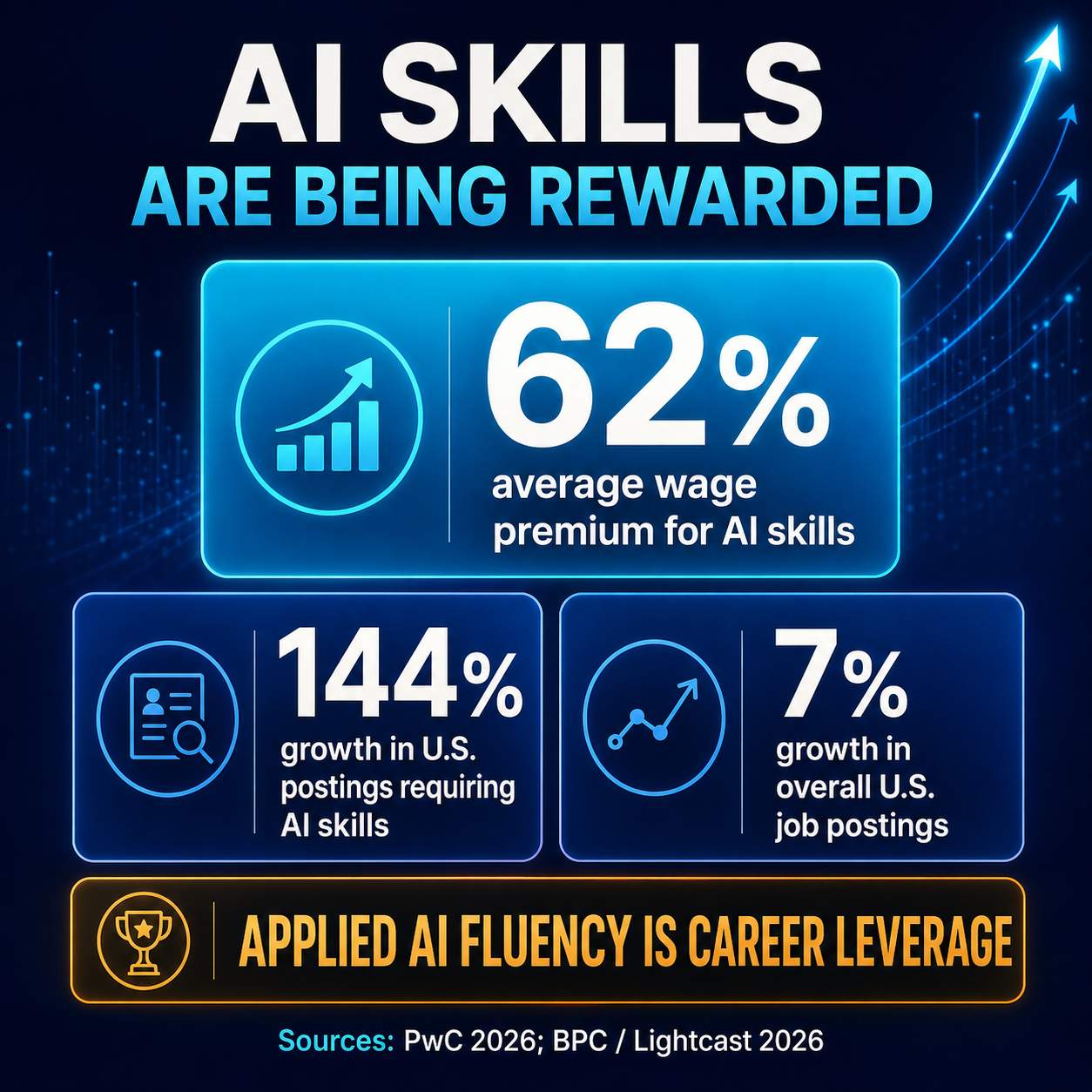
The campaign image accompanying this article highlights a 56% wage premium for AI skills. That figure comes from PwC’s 2025 analysis, which compared wages within occupations and found that workers whose roles required AI skills earned 56% more on average than workers in otherwise comparable roles without those requirements. (PwC Global Workforce Hopes and Fears Survey, 2025) The latest data strengthen the point. PwC’s June 2026 barometer reports that the average premium associated with AI skills has risen to 62%. The premium varies substantially by industry—from 16% in government and public-sector work to as much as 118% in consumer markets—so it should not be interpreted as a guaranteed raise for completing an AI course. It is a market signal showing how highly employers value scarce, applicable AI capability. (PwC, 2026) Demand is expanding just as quickly. The Bipartisan Policy Center’s AI Skills Dashboard, using Lightcast job-posting data, reported that US postings mentioning AI skills grew 144% year over year as of April 2026, compared with 7% growth across postings overall. The increase extended beyond technology into finance, higher education, engineering, accounting, manufacturing, and other sectors. (Bipartisan Policy Center, 2026) The valuable capability is not merely knowing how to open an AI application or write a clever prompt. Employers increasingly need professionals who can:
- identify where AI can improve a real workflow;
- provide the right context, data, constraints, and tools;
- evaluate outputs for accuracy, bias, risk, and commercial relevance;
- combine machine-generated analysis with domain knowledge;
- redesign the process around human accountability; and
- measure whether the system actually improves the desired outcome.
In other words, the premium belongs to applied AI fluency: the ability to turn AI capability into trustworthy business performance.
4. Flatter organizations may squeeze middle management
AI is also changing the organizational layers around knowledge work. Reporting, scheduling, task coordination, dashboard preparation, and routine performance monitoring have historically occupied a large share of middle-management time. These activities are increasingly automatable. Gartner forecast in October 2024 that, through 2026, 20% of organizations would use AI to flatten their organizational structures, eliminating more than half of their current middle-management positions. Gartner also warned that this could weaken mentoring and learning pathways, overwhelm managers with larger spans of control, and reduce development opportunities for junior employees. This is a forecast, not a confirmed measurement of what 20% of organizations have already done. (Gartner, 2024) The distinction matters. AI may automate parts of managing, but that does not mean every management function disappears. Coaching, conflict resolution, organizational sense-making, ethical accountability, talent development, and decision-making under ambiguity remain deeply human responsibilities. The strongest managers in a flatter organization will therefore spend less time transmitting information and more time:
- setting direction and making trade-offs;
- coaching people through unfamiliar problems;
- connecting decisions across teams and functions;
- maintaining trust during rapid change;
- reviewing high-impact AI-assisted decisions; and
- developing the next generation of leaders.
If organizations reduce management layers without rebuilding these functions elsewhere, they may gain short-term efficiency while creating long-term leadership debt.
Contact us to learn more about which AI Certificate may help to advance your career
5. The most valuable AI-era skills are increasingly human
As routine cognitive production becomes cheaper, the value of deciding what should be produced—and whether it is any good—rises. PwC found that new tasks added to highly AI-exposed roles are 2.5 times more likely to rely on human-intensive capabilities such as empathy, judgment, and creativity than new tasks in the least-exposed roles. It also found that the skill requirements of the most AI-exposed jobs are changing more than twice as fast as those of the least-exposed jobs. (PwC 2026 Global AI Jobs Barometer) The World Economic Forum’s Future of Jobs Report 2025 reaches a compatible conclusion from an employer survey. AI and big data lead the list of fastest-growing skills, but analytical thinking remains the most important core skill, considered essential by seven in ten surveyed companies. Creative thinking, resilience, leadership, social influence, empathy, active listening, curiosity, and lifelong learning also feature prominently. (World Economic Forum, 2025) This is not a paradox. AI can generate more options, drafts, recommendations, and analyses than any employee could review unaided. That abundance increases the need for people who can:
- frame the right problem;
- distinguish a plausible answer from a correct one;
- see second-order effects across a system;
- understand customer, regulatory, and organizational context;
- negotiate competing priorities;
- communicate a decision clearly; and
- accept accountability for the outcome.
Domain expertise also becomes more—not less—important. A generic model may know the vocabulary of finance, healthcare, engineering, law, safety, or supply-chain management. It does not automatically understand a particular organization’s operating constraints, risk tolerance, customers, data quality, or strategic intent. That context is where experienced human judgment creates leverage.
What organizations should do now
The evidence suggests that successful workforce strategy cannot be reduced to buying AI licences or cutting positions. Organizations need to redesign work and talent systems together. First, distinguish tasks from jobs. Identify which activities should be automated, which should be AI-assisted, and which require direct human ownership. A role rarely falls entirely into one category. Second, hire for paired capabilities. Technical AI fluency should be evaluated alongside judgment, communication, systems thinking, and domain expertise. A candidate who can operate an AI tool but cannot challenge its output is not yet ready for high-stakes application. Third, rebuild the leadership pipeline. If junior execution and middle-management coordination both shrink, create deliberate alternatives for apprenticeships, mentoring, stretch assignments, and progressive decision authority. Finally, measure value beyond hours saved. Track revenue enabled, cycle-time reduction, quality, customer outcomes, risk reduction, employee capability, and the number of new opportunities the organization can pursue.
What knowledge workers should do now
For professionals, the safest strategy is neither to ignore AI nor to compete with it at the tasks it performs most cheaply. Build enough AI fluency to redesign a workflow, not merely accelerate one task. Learn to provide context, connect tools and data, validate outputs, and document where human review is required. Then pair that fluency with a domain in which accuracy, trust, and commercial judgment matter. At the same time, deliberately strengthen the capabilities that become more valuable when production is abundant: critical thinking, systems thinking, clear writing, facilitation, negotiation, leadership, creativity, and empathy. The emerging career advantage is not “human versus AI.” It is the ability to decide what the technology should do, guide it toward a useful result, and take responsibility for what happens next.
Contact us to learn more about which AI Certificate may help to advance your career
The real shift: from labour substitution to capability expansion
AI will automate meaningful portions of knowledge work, and some roles will contract. That reality should not be minimized. But the broader evidence points to a more complex transformation. Career ladders are becoming steeper. Junior roles are demanding senior judgment earlier. Routine management work is being compressed. AI-capable firms are pulling ahead on productivity and, in many cases, headcount. Workers who can apply AI effectively are earning substantial market premiums. Meanwhile, empathy, creativity, leadership, and judgment are appearing more frequently in the work AI leaves behind or helps create. The organizations that win will not be those that automate the most work indiscriminately. They will be those that understand where automation reduces friction, where augmentation expands human capability, and how to develop people for the higher-value work that follows. AI isn’t just changing jobs. It is raising the value of human skill—and rewarding the people and organizations that know how to combine both.
Last Modification : 8/8/2026 1:33:19 AM