Brain Capital: The Most Valuable Asset in the New Economy
@admin 5/8/2026 6:41:06 PM
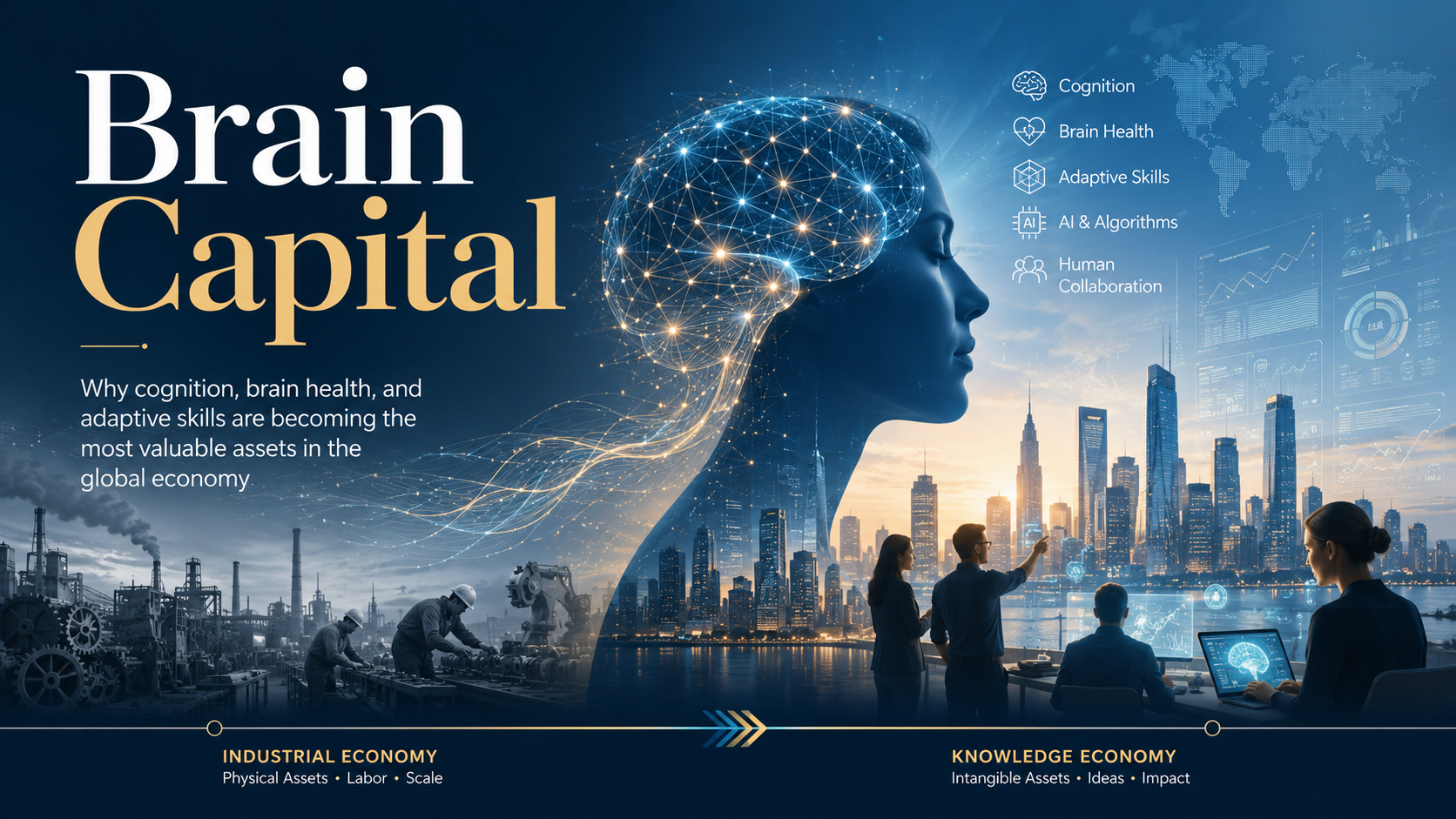
For most of the industrial era, economic value was anchored in things you could touch—factories, machinery, raw materials, and the routine human labor required to operate them. Wealth was measured in tonnes of steel, barrels of oil, and units shipped. That world is fading, and the one taking its place runs on something far less tangible: human cognition. The global economy is undergoing a structural paradigm shift of unprecedented magnitude. Value creation has migrated from physical assets and manual repetition toward ideas, algorithms, and the speed at which humans can learn, adapt, and synthesize. In this new landscape, the brain is no longer simply the engine of individual achievement—it is the central economic asset of the twenty-first century. Economists, public health experts, and policy thinkers have begun describing this new reality through a single unifying concept: Brain Capital.
What Is Brain Capital?
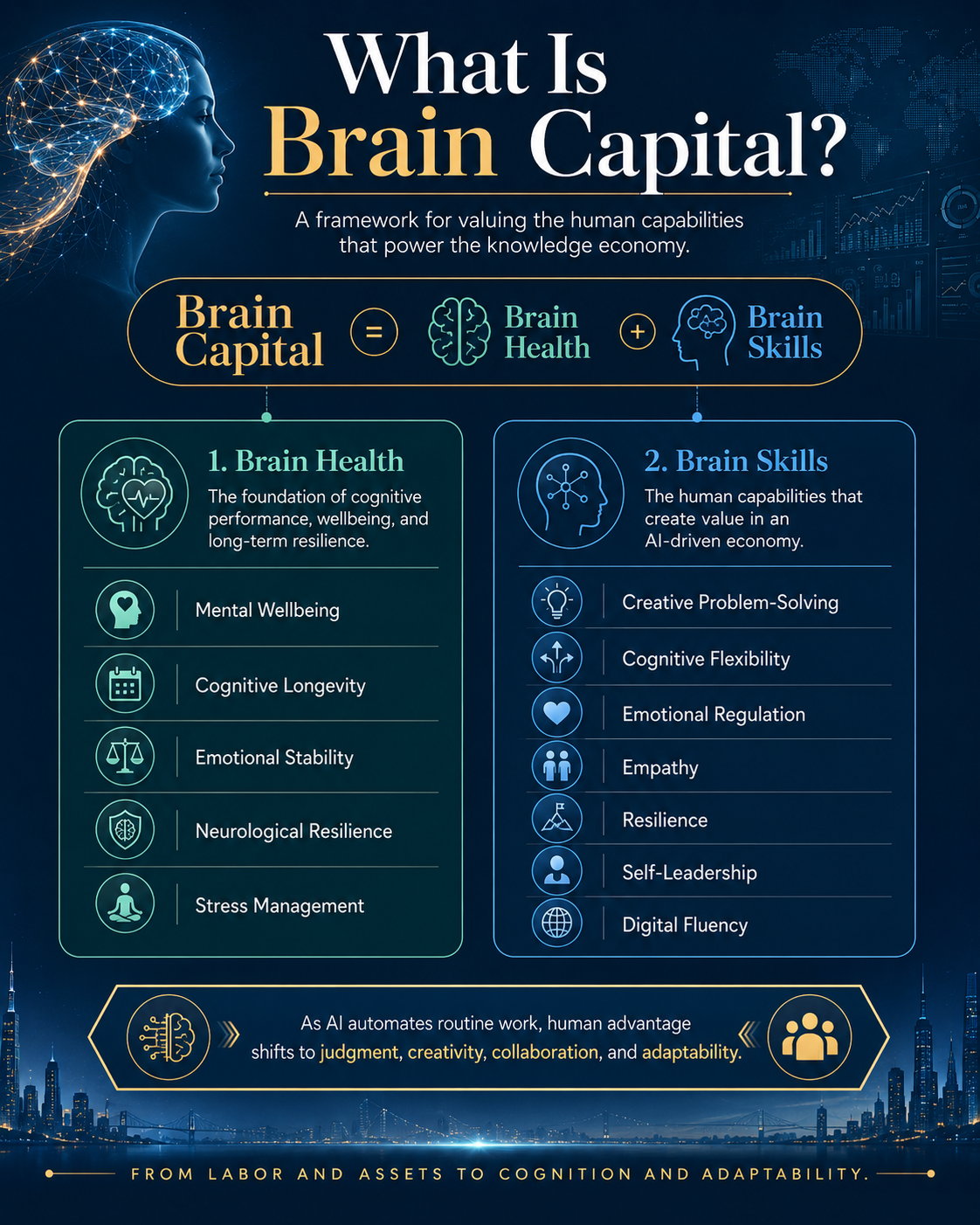
Brain Capital is a macroeconomic framework that treats brain health and brain skills as inseparable economic resources, as vital to national prosperity as physical infrastructure or financial reserves. It elevates cognition from a personal attribute to a measurable, investable form of capital—one that can be cultivated, depreciated, protected, or destroyed. The framework rests on two interdependent pillars. The first is brain health: the neurological, psychological, and emotional foundation that determines how well a person can think, feel, and function. The second is brain skills: the higher-order capabilities that translate that foundation into productive work, creative output, and adaptive decision-making. A workforce can have access to world-class education and still fail to perform if cognitive reserves are eroded by depression, chronic stress, or untreated neurological decline. Conversely, a healthy brain that lacks training in modern cognitive skills is increasingly underemployed in an economy that no longer rewards rote execution. Together, these two pillars form a single asset class. Brain health without skills is wasted potential. Skills without brain health are unsustainable performance. Treating either in isolation has been the central failure of twentieth-century human capital policy, and correcting that failure is the work of the decades ahead.
The Skills That Now Define Competitive Advantage
Brain skills encompass the foundational cognitive, interpersonal, self-leadership, and technological competencies required to navigate complex systems. They are the higher-order executive functions that humans, for now, still perform better than any algorithm. These include creative problem-solving, cognitive flexibility, emotional regulation, empathy, resilience, and the metacognitive ability to reason about one's own reasoning.
This matters because artificial intelligence and machine learning systems are absorbing repetitive, deterministic, and administrative tasks at a pace few labor markets have prepared for. Work that once required years of training—document review, basic coding, financial analysis, customer triage—is increasingly handled by software that learns and improves continuously. The competitive edge of the human workforce no longer lies in mastering routine; it lies in the capacities that machines cannot easily replicate. Curiosity. Judgment under uncertainty. The capacity to motivate a team, soothe a frustrated customer, or recognize when a problem has been framed incorrectly in the first place.
The Cost of Getting It Wrong
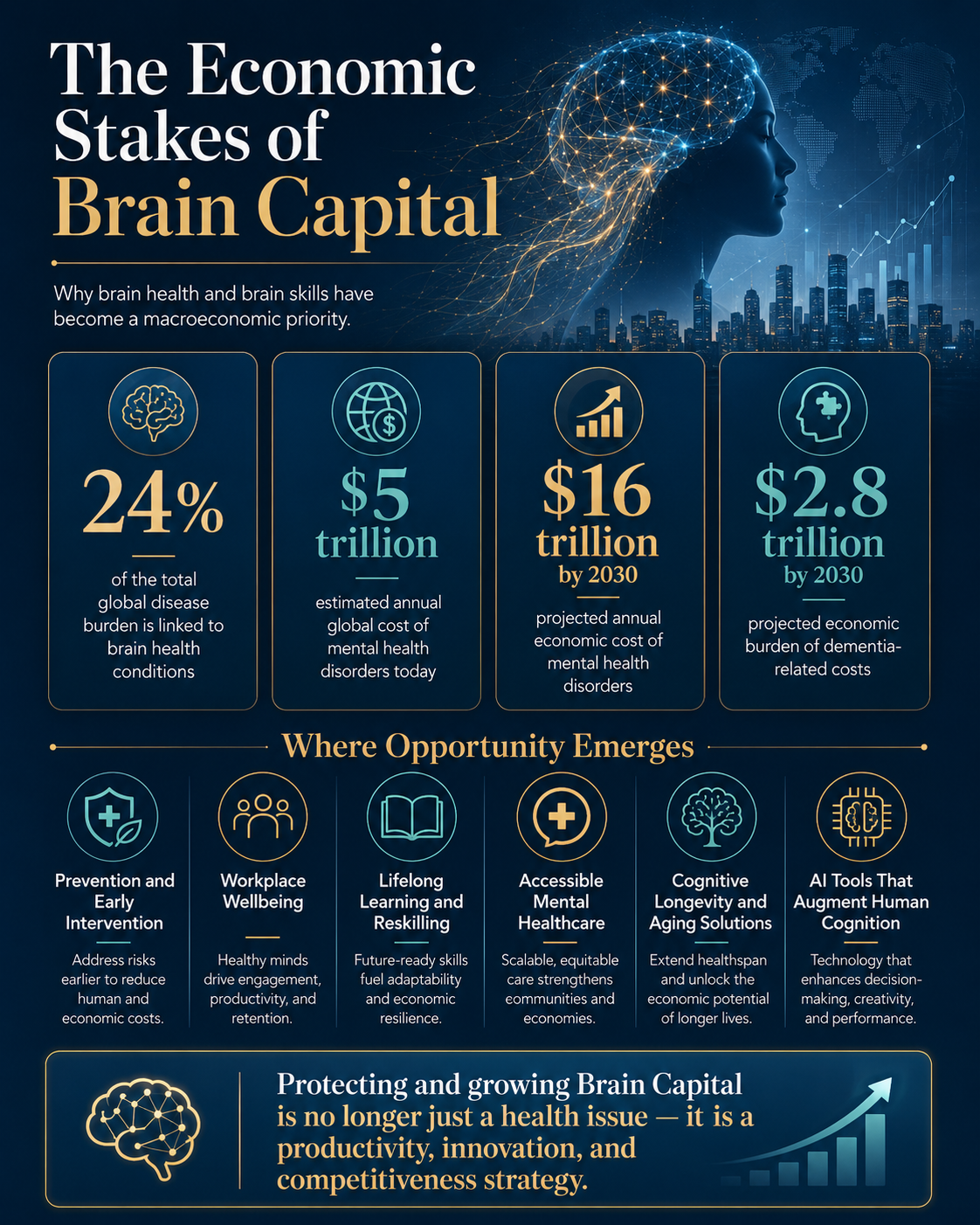
If Brain Capital is now the central asset of modern economies, the systems used to maintain and grow it remain alarmingly underdeveloped. The cost of that neglect is staggering and rising. Brain health conditions—including mental, neurological, and substance use disorders—account for roughly 24% of the total global disease burden. Mental health disorders alone cost the world economy approximately $5 trillion every year in lost productivity, treatment, and disability. Without serious intervention, that figure is projected to climb to $16 trillion by 2030. Dementia, driven largely by population aging, is on track to consume $2.8 trillion of global resources within the same timeframe. These are not abstract numbers. They translate into missed deadlines, abandoned careers, premature retirements, and entire family economies destabilized by caregiving demands. They show up in workforces that arrive present but cognitively absent, in entrepreneurs unable to sustain creative output, and in students whose attention has been fragmented before they ever enter the labor market. The losses do not fall evenly. Lower-income economies bear a disproportionate share, lacking the public infrastructure to detect and treat brain health conditions early. But even the wealthiest nations are watching their cognitive output erode under conditions their healthcare systems were not designed to address.
Why the Erosion Is Accelerating
Several trends are converging to compound the pressure on global Brain Capital simultaneously. Demography is the first. Most major economies are aging, and with age comes a rising prevalence of neurodegenerative conditions. The longer people live, the more brain-years are at risk, and the more central cognitive maintenance becomes to economic continuity. Environmental stress is the second. Air pollution, heat exposure, microplastic accumulation, sleep disruption, and chronic noise have all been linked to measurable declines in cognitive performance. The brain is exquisitely sensitive to its environment, and the environment in many parts of the world is becoming more hostile to it. Technological disruption is the third—and the most paradoxical. The same tools accelerating economic transformation are also imposing a tax on human cognition. Constant connectivity, algorithmically optimized attention capture, and the psychological friction of perpetual reskilling all chip away at focus, motivation, and emotional regulation. Workers are asked to learn faster, switch contexts more often, and absorb more information than at any prior point in human history, often without the supports needed to do so sustainably. The result is a quiet but compounding deterioration of global cognitive reserves at the precise moment when those reserves matter most.
A Trillion-Dollar Opportunity Hiding Inside a Trillion-Dollar Problem
There is a more optimistic way to read these numbers. A $16 trillion problem is also a $16 trillion market. The scale of the challenge defines the size of the prize for innovators, policymakers, and enterprise leaders willing to treat Brain Capital as the strategic frontier it has become. Scaling cost-effective interventions is now the defining commercial and policy challenge of the next decade. The opportunity is already taking shape in several directions at once. In healthcare and biotechnology, novel diagnostics for early-stage cognitive decline, digital therapeutics for depression and anxiety, and emerging classes of neuropharmaceuticals are rewriting what is treatable—and at what cost. In workplace technology, tools focused on cognitive load management, restorative breaks, and mental health support are evolving from wellness perks into core productivity infrastructure. In education, curricula are being redesigned around cognitive flexibility, metacognition, and AI-augmented reasoning rather than the memorization of facts machines now retrieve in seconds. Public-sector investment is following. A growing number of governments are integrating brain health metrics into their economic planning, recognizing that long-run GDP forecasts increasingly hinge on cognitive variables. Brain Capital indices, modeled on existing human capital indicators, are being developed to give policymakers a more accurate picture of where their populations stand and where intervention will yield the highest returns. For private capital, the implications are direct. Companies that protect and develop the brain capital of their workforces will outperform those that treat cognition as an unmanaged input. Investors who can identify scalable brain-health and brain-skills solutions stand to participate in one of the defining growth markets of the coming decades.
What Leaders Should Do Now
The transition to a Brain Capital economy will not happen automatically, and the institutions best prepared for it are already moving. For enterprise leaders, the priority is to stop treating brain health as the private burden of individual employees. Cognitive performance is a function of organizational design—of workload, autonomy, psychological safety, and the quality of management. Investing in the conditions that allow brains to function well is not a benefits expense; it is a productivity strategy. Companies that pair this with structured development of brain skills—creativity, collaboration, judgment, adaptability—will widen their advantage in markets where AI rapidly commoditizes everything else. For policymakers, the task is to build the public infrastructure of a cognitive economy. That means parity between mental and physical healthcare, screening for cognitive decline as a routine part of adult care, mental health support integrated into schools, and education systems redesigned around the skills humans will still own a generation from now. It also means treating environmental risk factors—pollution, sleep disruption, attentional exploitation—as economic risks, because they unambiguously are. For innovators and investors, the opportunity is to build the products, services, and platforms that the next economy will require. Tools that detect cognitive decline earlier, at lower cost, and at greater scale. Therapeutics, both digital and pharmacological, that meet the global mental health gap. Learning systems that develop brain skills from childhood through retirement. The market signals are unambiguous, and early movers are already attracting both capital and talent.
The Defining Question of the Next Economy
The transition from physical capital to brain capital is not a future scenario. It is a process already underway, visible in labor markets, in capital flows, in the strategic priorities of governments, and in the emerging contours of the AI-augmented workplace. The countries, companies, and communities that thrive in the decades ahead will be those that recognize human cognition for what it has become: a finite, precious, and economically central resource that demands the same seriousness of investment once reserved for railroads, factories, and oil fields. The ones that fail to make this turn will spend the next decade attempting to compete in a cognitive economy with industrial-era tools. Brain Capital is not a metaphor. It is the underlying asset class of the twenty-first century, and the choices being made now—by educators, employers, regulators, and investors—will determine whose brains are equipped to flourish in it, and whose are quietly left behind.
Last Modification : 5/8/2026 6:41:49 PM