Capability Infrastructure: Bosch and Walmart Examples
@admin 5/17/2026 1:07:43 PM
Why Bosch and Walmart Are Quietly Rewriting the Rules of Enterprise AI Adoption
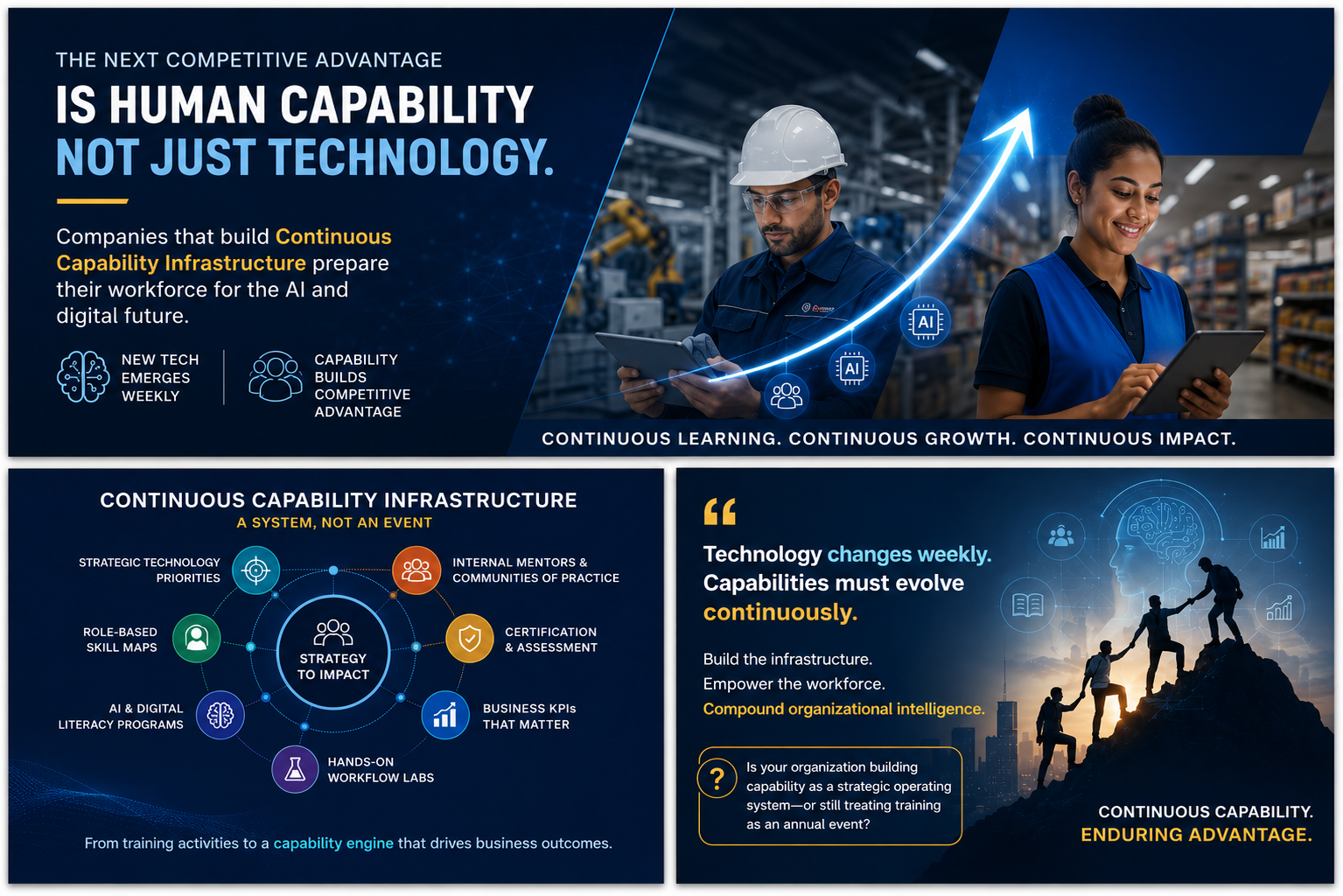
When two companies operating in radically different industries begin moving in the same strategic direction, it usually signals something larger than corporate coincidence. It signals that the ground beneath the entire economy is shifting. Consider what Bosch and Walmart have each announced in recent months. Bosch, the German industrial and engineering conglomerate, has been quietly engineering one of the most ambitious internal AI upskilling efforts in the global manufacturing sector. Roughly 100,000 of its associates have already completed AI-related training through the company's AI Academy. Parallel programs like MISSION TO MOVE and structured software qualification pathways are systematically preparing its workforce for a digitally native operating model. Walmart, the world's largest private employer, is making a structurally similar move from the opposite end of the economy. The retailer announced a collaboration with OpenAI to deliver free, customized AI training and certification to its U.S. frontline and corporate associates through Walmart Academy. The initiative builds on an existing commitment of nearly one billion dollars toward skills development through 2026. On the surface, these look like human resources initiatives — large, well-funded, and well-intentioned, but ultimately familiar in shape. They are not. What Bosch and Walmart are actually building is something the corporate vocabulary has not yet caught up with. Call it Continuous Capability Infrastructure: a permanent, enterprise-wide system for converting emerging technology into applied human capability at the speed the technology itself evolves. And it is rapidly becoming the most underappreciated source of competitive advantage in the AI era.
The Collapse of the Annual Learning Cycle
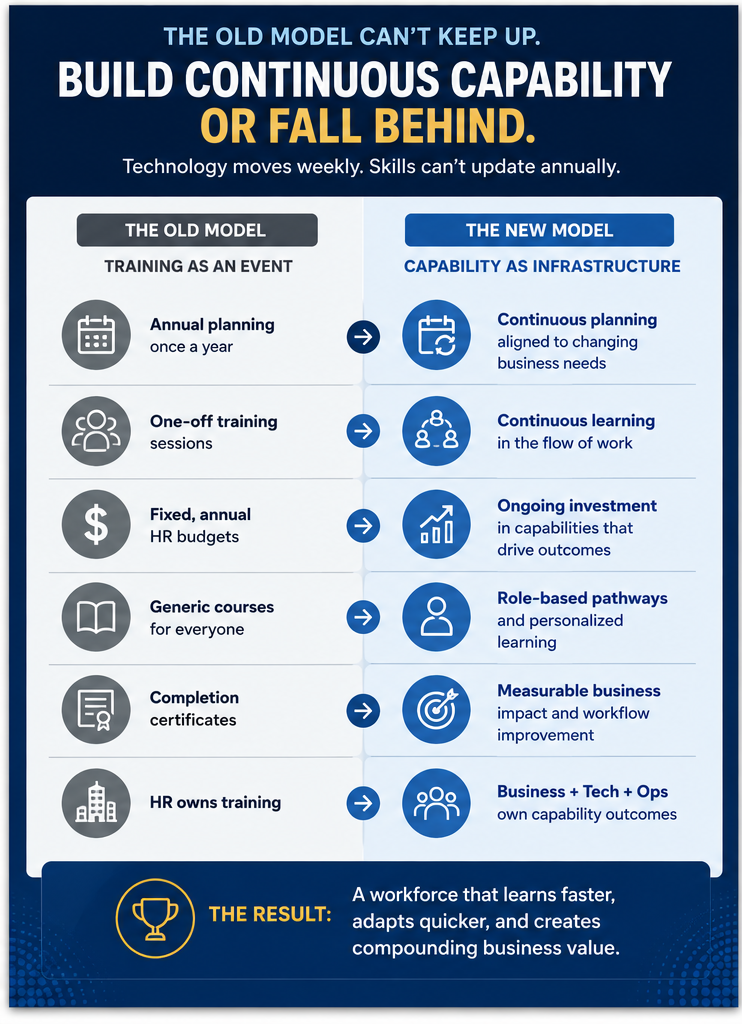
For most of the past half-century, corporate workforce development operated on an annual rhythm. Budgets were set once a year. Training calendars were published. Workshops were scheduled, attended, and logged. Completion rates were reported to the board. The cycle then reset. This model was not lazy. It was rational — a reasonable response to a world in which the dominant technologies of an industry might evolve over five-to-ten-year horizons. A factory floor in 1995 looked broadly similar to a factory floor in 2005. A back-office workflow in 2000 was recognizable in 2010. That world is gone. Generative AI capabilities are improving on quarterly, sometimes monthly, cycles. Cloud platforms ship meaningful changes on weekly release cadences. Automation tools, agentic systems, and integrated AI copilots are reshaping job tasks faster than most organizations can update their job descriptions. Customer expectations — shaped by their experiences with consumer AI products — are escalating in parallel. In this environment, the annual training cycle is not merely outdated. It is structurally incoherent. By the time a curriculum is designed, approved, procured, and delivered, the underlying technology has often moved past the lesson plan. The World Economic Forum's Future of Jobs Report 2025 estimates that 39 percent of workers' core skills will change by 2030. McKinsey's recent work on AI adoption argues that effective upskilling must now be continuous, peer-driven, and embedded directly in the flow of daily work — a sharp departure from the classroom-and-certificate paradigm that has dominated corporate learning for decades. The implication is uncomfortable but unavoidable: the gap between business strategy and workforce capability has migrated out of the HR function and into the domain of operational risk.
What Bosch and Walmart Actually Understand
The most important thing to recognize about the Bosch and Walmart programs is what they are not. They are not larger versions of conventional training. They are not better-marketed corporate universities. They are not feel-good investments in employee development designed to soften the optics of automation. They are early prototypes of a new organizational layer — one that sits alongside technology infrastructure, data infrastructure, and operational infrastructure, and performs an equally load-bearing function. This layer has a specific job: to continuously translate the organization's evolving technology stack into the evolving practical capability of the people who use it. That is a meaningfully different mandate from "training." Training delivers content. Capability infrastructure delivers fluency, judgment, and applied competence — at scale, on a rolling basis, across every relevant role. In Bosch's case, the infrastructure is calibrated to industrial and engineering contexts: AI applied to design, manufacturing optimization, predictive maintenance, and product development. In Walmart's case, the infrastructure is calibrated to retail and frontline contexts: AI applied to customer service, inventory, merchandising, and corporate decision support. The industries differ. The architecture is the same.
The Real Competitive Frontier
For the past three years, the dominant narrative around enterprise AI has focused on the supply side of the equation: which models are most capable, which platforms scale most efficiently, which vendors offer the best integration, which data assets confer the most defensible advantage. These questions matter. But they are increasingly necessary rather than sufficient conditions for competitive advantage. The harder, more decisive question is one almost no one is asking publicly: How quickly can your organization convert a new technological capability into a changed human behavior at scale? This is the bottleneck. A multinational can procure access to frontier AI models in a matter of weeks. Integrating them into core systems takes longer, but is increasingly a solved engineering problem. The truly intractable challenge is the last mile — getting tens of thousands of employees to apply these tools competently, govern them responsibly, challenge their outputs intelligently, and redesign their workflows around them. Without that last mile, AI investments become what one CIO recently described to me as "very expensive shelfware with excellent press releases." This is the trap most organizations are currently walking into. They are treating AI adoption as a technology rollout when it is, in fact, a capability transformation. The two require fundamentally different operating models.
The Architecture of Capability Infrastructure
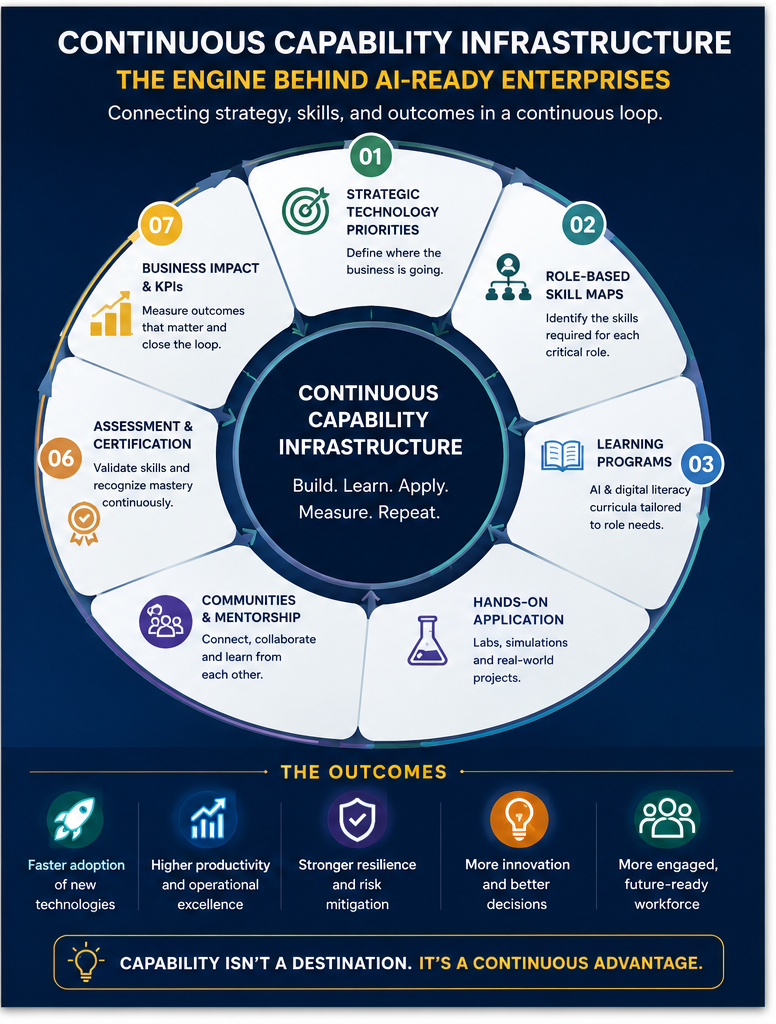
What does Continuous Capability Infrastructure actually look like when it is built well? Based on what Bosch, Walmart, and a handful of other early movers are doing, the components are becoming recognizable. It begins with a tight coupling between strategic technology priorities and role-based skill maps — so that capability development is driven by where the business is heading, not by where last year's training catalog left off. It includes structured AI and digital literacy programs that scale baseline fluency across the entire organization, paired with hands-on workflow labs where employees apply new capabilities to their own actual work rather than to generic case studies. It depends heavily on internal mentors and communities of practice, because the research is now unambiguous: peer-driven learning embedded in real work consistently outperforms classroom instruction for adult professionals adopting new technologies. It is reinforced by certification and assessment systems that measure applied competence rather than seat time. And critically, it ties capability investment directly to business KPIs — productivity, quality, safety, customer experience, and innovation throughput — rather than to the vanity metrics of completion rates and satisfaction scores. The shift this represents can be summarized in five transitions: from training sessions to learning systems, from annual budgets to continuous investment, from generic courses to role-based pathways, from HR-owned programs to jointly-owned business-technology-operations programs, and from completion certificates to measurable workflow improvement. Each transition is, on its own, a meaningful change. Together, they constitute a different organizational species.
Funding Capability as Infrastructure, Not as Benefit
One of the quietest but most consequential implications of this shift involves how capability investment is classified inside organizations. For most companies, learning and development sits in the HR budget — categorized alongside benefits, wellness programs, and employee engagement initiatives. It is funded as a cost of doing business, not as a driver of competitive position. This classification was always somewhat strange, but in the AI era it becomes actively dangerous. Capability infrastructure is not a benefit. It is the substrate on which digital execution actually happens. Cloud infrastructure powers digital products. Data infrastructure powers digital insight. Capability infrastructure powers digital execution. Treating it as anything less is a category error — one that explains, with surprising precision, why so many enterprise AI initiatives stall at the pilot stage. The technology works. The data is available. The strategy is sound. But the organizational nervous system required to translate all of that into changed behavior at scale was never built, never funded, and never owned by anyone with the authority to make it real.
What Comes Next
The companies that will define the next decade of enterprise AI are unlikely to be the ones with the largest model budgets or the most aggressive vendor relationships. They will be the ones that build the fastest, most durable learning loops between technology, work, and people. This is the deeper signal in the Bosch and Walmart announcements. Two of the largest and most operationally complex employers on earth — operating in entirely different industries, geographies, and workforce structures — have independently arrived at the same conclusion: that continuous capability is not a program to be funded but an infrastructure to be built. The leadership question this raises is uncomfortable but clarifying. Most organizations are still funding workforce development as an annual HR activity, defended by completion metrics and engagement surveys. A smaller and growing number are building it as a strategic operating system, defended by its measurable contribution to business performance. Only one of these approaches is going to survive contact with the next five years of technological change. The other will be remembered as a category of expense that quietly defined which companies adapted and which did not.
Last Modification : 5/17/2026 1:14:06 PM