- General Settings
- Appearance
-
Language
- English / EN
- Arabic / AR
- Czech / CS
- Finnish / FI
- Chinese (Simplified) / ZH
- English (United Kingdom) / EN-GB
- Chinese (Traditional) / ZH-HANT
- French / FR
- Icelandic / IS
- German (Germany) / DE
- Hindi / HI
- Hungarian / HU
- Slovak / SK
- Portuguese (Brazil) / PT
- Russian / RU
- Italian / IT
- Romanian (Romania) / RO
- Spanish / ES
- Turkish / TR
- Swedish / SV
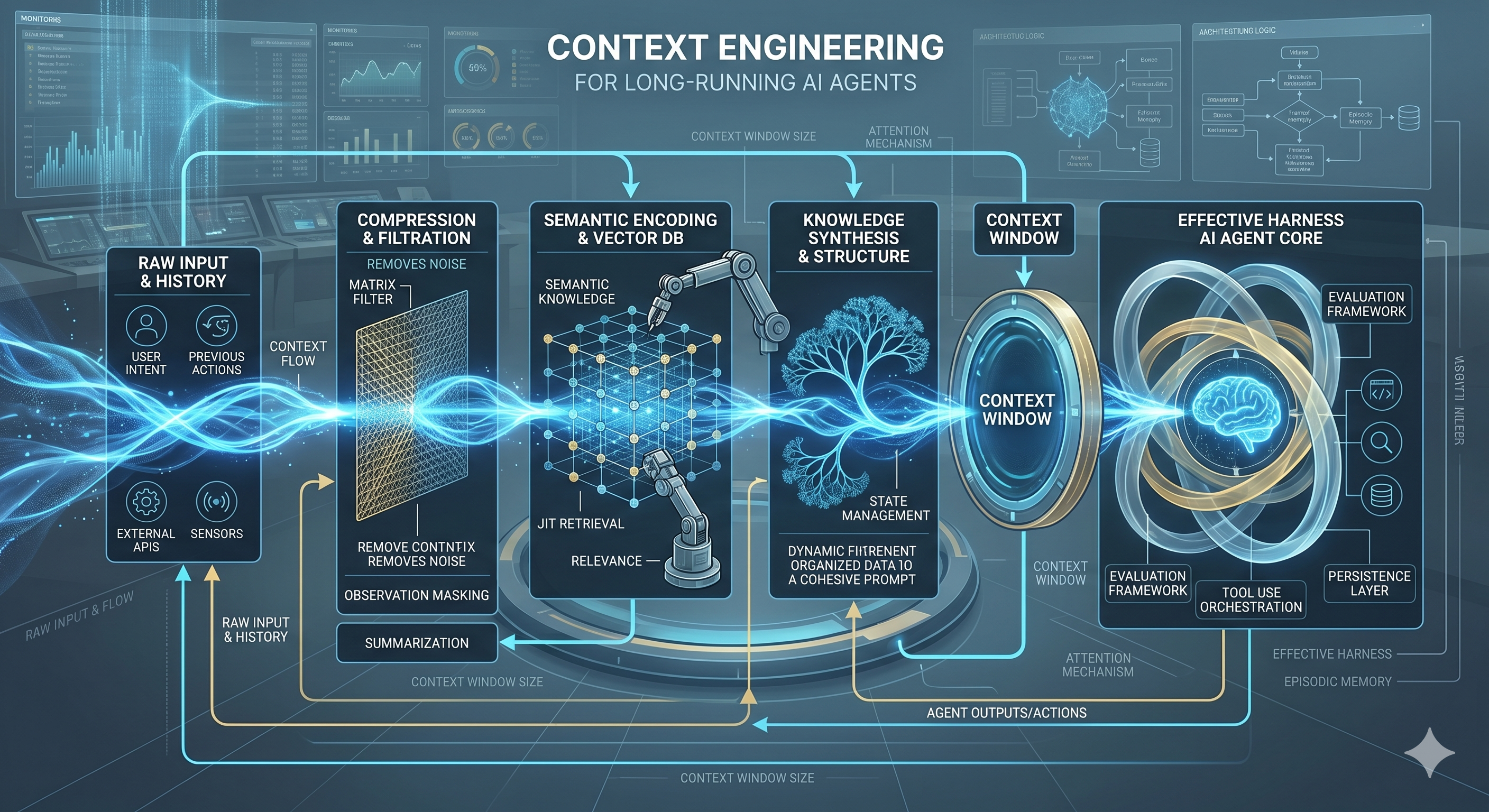
Context Engineering
@admin 4/30/2026 1:26:16 AM
Foundations of Context Engineering
Why the next frontier of AI systems is not better prompts, but better managed context
For the last few years, most teams working with large language models have focused heavily on prompt engineering. That made sense. When LLMs first became broadly usable, the fastest way to improve output quality was to write better instructions: clearer roles, better examples, stronger constraints, more precise formatting rules, and more explicit success criteria. But as AI systems move from simple chat interactions into enterprise workflows, software agents, retrieval-augmented systems, autonomous task execution, and multi-step operations, prompt engineering is no longer enough. The real challenge is no longer just:
“What should I say to the model?”
The deeper question is:
“What should the model know, remember, retrieve, ignore, summarize, forget, and act on at every step of the task?”
That is the foundation of context engineering.
What Context Engineering Actually Is
Prompt engineering optimizes a single message. Context engineering optimizes the entire information environment a model sees when it makes a decision. That information environment may include:
- System instructions
- Developer instructions
- User messages
- Prior conversation turns
- Retrieved documents
- Tool definitions
- Tool results
- Memory
- Summaries
- Scratchpads
- Planning artifacts
- Intermediate reasoning outputs
- Structured output schemas
- Workflow state
- Agent goals
- Human feedback
- Other agents’ outputs
In other words, the model is not simply responding to a prompt. It is responding to a constructed context. A useful working definition is:
Context engineering is the discipline of designing what enters and what leaves an LLM’s context window, across time, such that the model can reliably perform a task it could not perform from a single prompt alone.
Three phrases in that definition matter. First: “across time.” The most interesting AI system problems are temporal. Single-turn behavior is relatively easy. The hard problems appear when an AI system must stay coherent across multiple turns, many tool calls, long-running workflows, restarts, sessions, users, and agents. Second: “enters and leaves.” Context is finite. Every token added to the context window displaces something else. Context engineering is not just about injecting more information. It is also about deciding what to remove, compress, summarize, archive, or retrieve later. Third: “could not perform from a single prompt.” If a task works well zero-shot with one prompt, you probably do not need a full context engineering discipline. You need context engineering when the model must work with evolving state, changing goals, multiple data sources, tool outputs, and memory over time.
The Shift from Prompt to Context
There is a common maturity curve in how teams adopt LLMs. At first, teams begin with better prompts. Then they add retrieval. Then they add tools. Eventually, they realize the system is no longer failing because of one bad prompt. It is failing because the model is seeing the wrong information at the wrong time. That is the shift from prompt engineering to context engineering.
| Generation | Primary Lever | Typical Failure Mode | |
-- |
- |
| | G1: Prompt Engineering | Better instructions in a single message | Brittle on edge cases; no durable memory | | G2: RAG | Inject relevant documents at query time | Retrieval misses, stale context, weak task continuity | | G3: Agents | Let the model call tools and loop | Context bloat, drift, forgotten goals, runaway cost | | G4: Context Engineering | Treat context as a managed resource over time | Requires architecture, telemetry, and governance |
Most teams today are somewhere between G2 and G3. They have a RAG pipeline. They have tool calling. They may even have an “agent” loop. But after enough steps, things start to break. The model forgets the original goal. The context fills with low-value tool outputs. The agent repeats work it already completed. The system retrieves documents that are technically relevant but operationally distracting. The prompt gets longer, but performance does not improve. Cost and latency rise while reliability declines. At that point, adding another instruction is not the answer. The system does not have a prompt problem. It has a context problem.
Context as a Managed Resource
A helpful way to think about context is as a bandwidth-limited channel between the world and the model. The world includes the user, documents, APIs, databases, tools, previous conversations, business rules, workflow state, and external systems. The model only sees a small slice of that world at any given time. The job of context engineering is to decide which slice matters now. Two quantities become especially important:
1. Signal Density
Signal density means:
Useful tokens divided by total tokens in context.
A context window full of raw logs, long tool responses, repeated instructions, duplicated documents, and stale conversation history has low signal density. A context window containing the current goal, relevant constraints, recent decisions, active state, and the right supporting evidence has high signal density. More context is not automatically better. Better context is better.
2. Goal Alignment
Goal alignment means:
The fraction of context that points the model toward the current sub-goal instead of an old, irrelevant, or conflicting goal.
This matters because agents often move through phases. A sales assistant may start by qualifying a lead, then gather product requirements, then generate a quote, then update a CRM, then draft an internal handoff. Each phase requires different context. If the model continues to carry too much stale context from earlier phases, it may over-focus on outdated information and underperform on the current task. Good context engineering keeps the model oriented toward the right goal at the right moment.
The Trade-Offs: Cost, Latency, and Accuracy
Every context decision has a cost. Adding more information may improve the model’s chances of answering correctly, but it also increases input tokens, latency, and sometimes confusion. The main trade-offs are:
| Trade-Off | Why It Matters | |
- |
-- | | Cost | Input tokens are billed repeatedly, especially in multi-turn systems. | | Latency | Larger contexts usually increase time to first token and total response time. | | Accuracy | Long contexts can dilute attention, bury key facts, and cause “lost in the middle” failures. | | Reliability | Irrelevant or conflicting context can make the model behave inconsistently. | | Governance | Sensitive, stale, or unauthorized information may accidentally enter the context. |
A strong context engineering decision asks:
“Am I increasing signal density and goal alignment without paying disproportionately in cost, latency, accuracy, or risk?”
That question is more useful than simply asking:
“Should I add this to the prompt?”
Because in production AI systems, context is not just prompt text. It is an engineered runtime asset.
Why Long-Running Agents Are the Hard Case
A single-turn assistant starts fresh every call. A long-running agent does not. It accumulates messages, tool results, decisions, partial outputs, errors, retries, user corrections, and state transitions. It may operate for minutes, hours, days, or across multiple sessions. That is where naive approaches collapse. A long-running agent is difficult because it is often:
Token-Long
The full trajectory of the task may exceed the model’s context window by 10×, 50×, or even 100×. You cannot simply concatenate everything and send it back to the model. You need strategies for summarization, retrieval, compression, checkpointing, and selective reconstruction.
Wall-Clock-Long
Some workflows span sessions, restarts, or days. The model may need to resume a task after time has passed. It may need to know what was done, what remains, what changed, and what assumptions are no longer valid. This requires durable state, not just chat history.
Tool-Deep
Agents that use tools generate a lot of intermediate noise. Search results, API responses, database records, error logs, code snippets, file contents, stack traces, and validation outputs can quickly overwhelm the context window. Without context discipline, the agent becomes buried in its own tool exhaust.
Multi-Actor
In enterprise systems, context is often shared or modified by multiple actors. A user may update requirements. Another agent may perform research. A human reviewer may approve or reject a step. A workflow engine may change the task state. A CRM, ERP, or ticketing system may update the source of truth. Now the question is not only “what should the model know?” It is also:
“Who is allowed to write to the context, what authority does that context have, and how should conflicts be resolved?”
That is no longer prompt engineering. That is system design.
Common Symptoms of Context Failure
Many teams misdiagnose context failures as prompt failures. They keep rewriting the system prompt, adding more rules, or increasing the length of instructions. But the underlying issue remains. Here are common signs that your AI system has a context engineering problem:
| Symptom | Likely Context Issue | |
--- |
| | The agent forgets the original goal | Missing or poorly maintained goal state | | The model repeats work already completed | No durable task memory or checkpointing | | The agent follows outdated instructions | Stale context not being evicted | | Tool results overwhelm the conversation | Raw tool outputs not summarized or filtered | | RAG retrieves “related” but unhelpful documents | Retrieval optimized for similarity, not task relevance | | The model ignores important facts | Key information buried too deep in the context | | Costs rise sharply over long runs | Context bloat from unnecessary history | | The agent becomes inconsistent over time | Conflicting instructions or ungoverned memory | | The system fails after many steps but works in demos | No long-horizon context strategy |
A simple test is this:
If making the prompt longer does not fix the problem, it is probably a context problem.
The New Engineering Discipline
Context engineering sits at the intersection of several disciplines:
- Prompt design
- Retrieval architecture
- Memory systems
- Agent orchestration
- Workflow state management
- Tool design
- Information architecture
- Evaluation
- Observability
- Security and governance
This is why it is becoming a new engineering discipline. It is not just about writing clever prompts. It is about designing the information lifecycle around an intelligent system. That includes questions like:
- What should be included in the model’s immediate context?
- What should be stored externally?
- What should be summarized?
- What should be retrieved only when needed?
- What should be forgotten?
- What should be treated as authoritative?
- What should be treated as temporary?
- What should be visible to the model but not persisted?
- What should be persisted but not always shown?
- What telemetry tells us the context strategy is working?
These are architectural questions. And as AI systems become more agentic, they become unavoidable.
A Practical Mental Model
A production-grade context system usually needs at least five layers.
1. Instruction Context
This includes system prompts, developer instructions, policies, role definitions, tone, constraints, and output requirements. This layer tells the model how it should behave.
2. Task Context
This includes the user’s current goal, active sub-goal, task plan, acceptance criteria, and current progress. This layer tells the model what it is trying to accomplish now.
3. Knowledge Context
This includes retrieved documents, knowledge base snippets, codebase references, product data, policies, and external facts. This layer tells the model what information is relevant to the task.
4. State Context
This includes memory, prior decisions, completed steps, open issues, tool outputs, workflow state, and checkpoints. This layer tells the model what has already happened.
5. Output Context
This includes schemas, formatting rules, validation requirements, downstream API contracts, and structured response formats. This layer tells the model how the result must be produced. A failure in any one of these layers can degrade the entire system.
Context Engineering Is Mostly About Selection
The instinct of many teams is to add more. More instructions. More documents. More examples. More memory. More tool output. More conversation history. But context engineering is often about subtraction. The best context is not the largest context. The best context is the smallest context that contains enough high-quality signal for the model to make the right decision. That means context engineering requires active selection:
- Keep the current goal visible.
- Keep current constraints visible.
- Keep recent decisions visible.
- Retrieve only relevant supporting evidence.
- Summarize long tool outputs.
- Evict stale details.
- Store durable facts outside the prompt.
- Reconstruct context based on the current phase of the task.
A well-engineered context window should feel intentional. Nothing should be there by accident.
Reflection Checkpoint
Before moving deeper into context engineering, evaluate a real system you have built or are about to build. Ask yourself:
- What is the longest a single agent run lasts in your system, measured in both tokens consumed and wall-clock time?
- If you concatenated every message, tool result, retrieved document, and intermediate output from that run into a single prompt, would it fit inside your model’s context window?
- If it would not fit, by what factor would it exceed the window?
- Which of your current failures are truly prompt problems?
- Which failures are context problems?
- Do you have telemetry that shows context size, retrieved document count, tool-call volume, token cost, latency, and failure points over time?
That last question is critical. If you cannot answer it, that is your first homework.
You cannot engineer what you cannot measure.
Conclusion: The Future Belongs to Context-Aware Systems
The next generation of AI applications will not be won by teams with the longest prompts. They will be won by teams that know how to manage context as a strategic resource. Prompt engineering helped us learn how to speak to models. RAG helped us connect models to knowledge. Agents helped us connect models to tools. Context engineering brings these together into a disciplined approach for building AI systems that can operate across time, tools, memory, workflows, and changing goals. That is the foundation of reliable agentic software. The future is not just better prompts. The future is better context.
Last Modification : 5/1/2026 4:28:02 PM
In This Document
Subscribe to the newsletter!
Get information about the latest happenings.
Platform
- Curriculum
- Blog
- FAQ