- General Settings
- Appearance
-
Language
- English / EN
- Arabic / AR
- Czech / CS
- Finnish / FI
- Chinese (Simplified) / ZH
- English (United Kingdom) / EN-GB
- Chinese (Traditional) / ZH-HANT
- French / FR
- Icelandic / IS
- German (Germany) / DE
- Hindi / HI
- Hungarian / HU
- Slovak / SK
- Portuguese (Brazil) / PT
- Russian / RU
- Italian / IT
- Romanian (Romania) / RO
- Spanish / ES
- Turkish / TR
- Swedish / SV
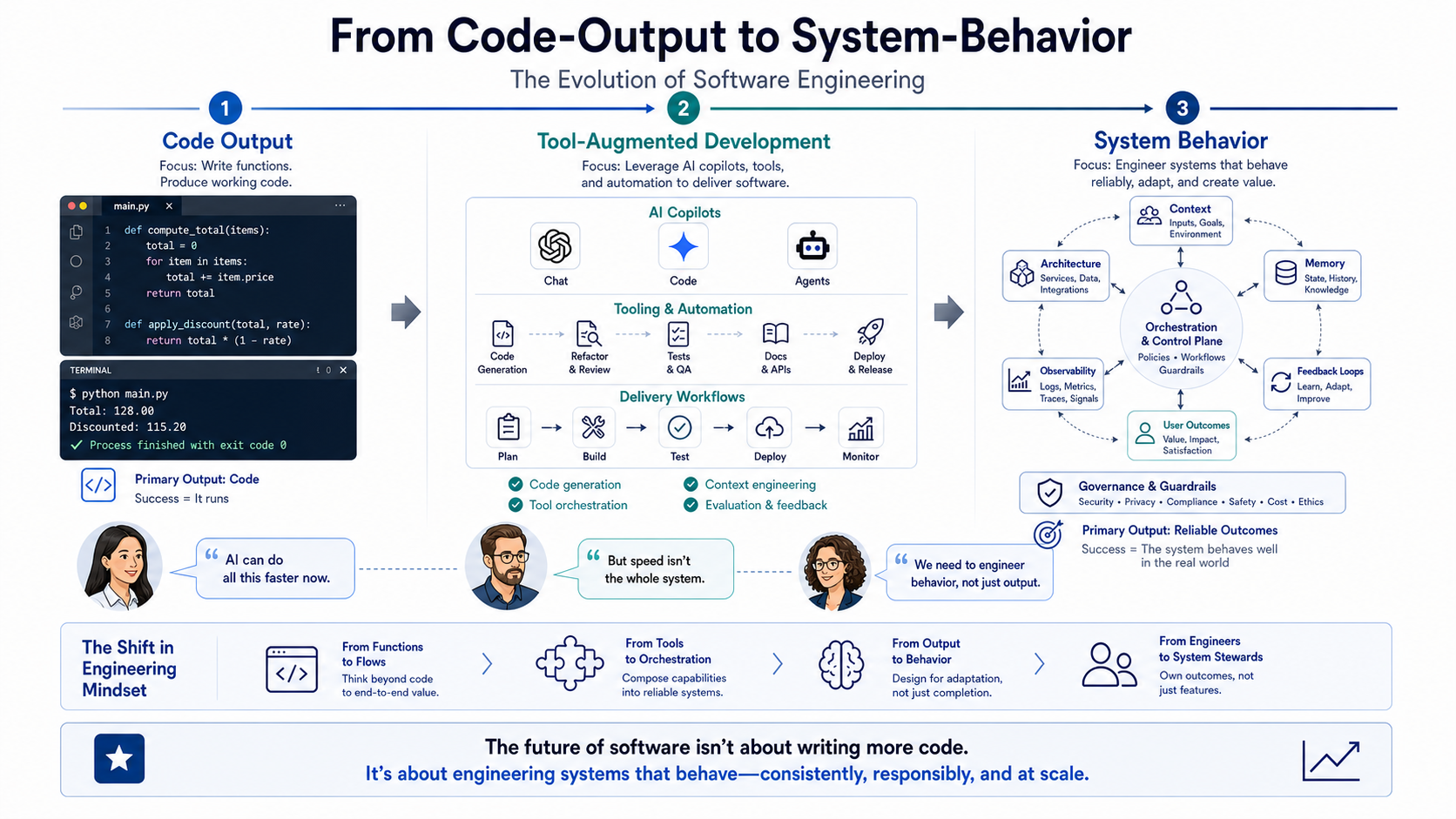
The Evolution of Software Engineering
@admin 5/3/2026 1:10:42 PM
From Code Output to System Behavior: The Evolution of Software Engineering
Software engineering is changing — and not only because of AI. AI is the most visible catalyst. Copilots, coding agents, automated test generation, deployment pipelines, and orchestration frameworks have made it possible to produce software faster than ever before. Teams can generate code, refactor services, write documentation, create test cases, and ship features at a speed that would have felt unrealistic just a few years ago. But the deeper shift is not simply that engineers can write code faster. The deeper shift is that code is no longer the primary unit of value. For years, software engineering success was often measured by a fairly direct question: Does the code work? That question still matters. It will always matter. But it is no longer enough. Today, the more important question is: Does the system behave? Does it behave reliably under real-world conditions? Does it adapt when inputs change? Does it respect constraints, policies, and user intent? Does it fail safely? Does it produce useful outcomes, not just technically correct outputs? Does it improve over time through feedback? This is the evolution now taking place across software engineering: from writing code that runs, to building systems that behave well in production, for real users, in real conditions.
The Old Definition of Success: Code That Runs
In the earlier era of software engineering, the deliverable was relatively clear: write working code. A developer was given a requirement, a bug, or a feature request. The task was to translate that into functions, classes, APIs, database queries, or scripts. Success was often measured by whether the code compiled, passed tests, and produced the expected output. This was the era of code output. The mindset was straightforward:
Write functions. Make them run. Ship the feature.
The center of gravity was the individual code artifact. The engineer’s craft was expressed through syntax, algorithms, structure, and implementation detail. A good engineer could reason deeply about edge cases, performance, abstractions, and maintainability. That still matters. Clean code, sound architecture, and technical discipline are not going away. But this model had a limitation: it treated software too much like a static artifact. In reality, software is not static. It operates inside messy environments. It interacts with users, data, infrastructure, third-party services, business rules, security constraints, and changing expectations. A piece of code can “work” in isolation and still fail to produce the right outcome in the real world. A function can return the expected value. An API can respond successfully. A deployment can complete. And yet the system can still behave poorly. That is why the definition of engineering success had to expand.
The Productivity Explosion: Tool-Augmented Development
Then came a new wave of tooling. AI copilots helped developers generate code faster. Automation improved testing, deployment, observability, and incident response. Agents began handling multi-step tasks. Low-code and no-code tools accelerated internal applications. Platform engineering gave teams reusable infrastructure and delivery workflows. This became the era of tool-augmented development. The mindset shifted from:
Can I write this code?
to:
How quickly can I compose the tools, workflows, and automations needed to deliver this?
In this era, productivity increased dramatically. A single engineer could do more. Small teams could move faster. Boilerplate work decreased. Documentation became easier to produce. Test generation became more accessible. Deployment workflows became more repeatable. The success metric also changed:
Success = it ships fast.
This was a meaningful improvement. Speed matters. Delivery matters. Reducing friction matters. Teams that can learn and ship faster have a real advantage. But speed introduces a new problem. When software becomes easier to produce, teams can create more of it. More code. More services. More integrations. More automations. More dependencies. More generated artifacts. More decisions happening inside systems that are increasingly dynamic. The bottleneck moves. It is no longer only about producing software. It becomes about understanding, coordinating, governing, and improving the behavior of the systems we have created. AI makes this even more obvious. When a system can generate content, call tools, retrieve context, interact with users, make recommendations, trigger workflows, or adapt its responses based on memory and feedback, then correctness is no longer just a property of code. Correctness becomes behavioral.
The New Center of Gravity: System Behavior
The next era is not simply about writing more code or adding more tools. It is about engineering system behavior. That means designing systems that can operate reliably across changing conditions. Systems that understand context. Systems that use memory appropriately. Systems that are observable. Systems that incorporate feedback. Systems that operate within guardrails. Systems that produce outcomes aligned with user needs, business goals, safety expectations, and operational constraints. In this era, the primary question becomes:
Does the system behave well in the real world?
That question is much harder than “does the code run?” Because behavior is not just an implementation detail. Behavior emerges from the interaction of many parts: Code. Data. Architecture. Infrastructure. User context. Model behavior. APIs. Workflows. Policies. Memory. Observability. Feedback loops. Security controls. Human review. Operational processes. A system’s behavior is the result of all of these elements working together. This is especially true in AI-enabled systems, but it is not limited to AI. Distributed systems, cloud platforms, event-driven architectures, microservices, personalization engines, recommendation systems, financial platforms, healthcare software, and enterprise automation all face the same reality. The value is not in the code alone. The value is in the behavior the code enables.
Why “It Works” Is No Longer Enough
The phrase “it works” can be misleading. A feature may work in a demo. A model may work on a test prompt. An integration may work in staging. An automation may work for the happy path. A service may work during normal traffic. But real systems operate outside the happy path. Users behave unpredictably. Data changes. Downstream services fail. Prompts are ambiguous. Business rules evolve. Security threats appear. Latency fluctuates. Models hallucinate. Edge cases multiply. A workflow that looks elegant in a diagram can produce surprising outcomes once it meets production reality. That is why behavior must be engineered, not assumed. A system that behaves well is not just functional. It is reliable, understandable, observable, resilient, and aligned with intent. It answers a broader set of questions: Does it do the right thing when the input is incomplete? Does it know when not to act? Can it explain or expose why something happened? Can humans intervene when needed? Does it degrade gracefully? Does it protect sensitive data? Does it avoid unsafe or unintended actions? Can it learn from feedback without becoming unpredictable? Can the team monitor and improve it over time? These are not just product questions. They are engineering questions.
The Mindset Shift: From Functions to Flows
The first major mindset shift is moving from functions to flows. Traditional software development often focused on discrete units of logic: functions, endpoints, components, modules. Those units still matter, but users experience software as flows. A user does not care that one function succeeded. They care whether the full journey worked. Did the onboarding flow help them get started? Did the support workflow resolve their issue? Did the recommendation engine provide something useful? Did the internal automation complete the business process correctly? Did the AI assistant understand the task across multiple steps? Engineering teams increasingly need to think beyond isolated outputs and toward end-to-end value. That means understanding how code, data, interfaces, models, and workflows combine into real user experiences. It also means measuring success at the level of outcomes, not just implementation. The unit of design is no longer only the function. It is the flow.
From Tools to Orchestration
The second shift is moving from tools to orchestration. Modern teams have no shortage of tools. They have copilots, CI/CD pipelines, cloud platforms, monitoring dashboards, feature flag systems, agent frameworks, workflow engines, vector databases, APIs, and automation layers. But tools alone do not create reliable systems. In fact, too many disconnected tools can create fragmentation. Each tool may be useful on its own, but without orchestration, the system becomes difficult to reason about. The engineering challenge is no longer just choosing the right tool. It is composing tools into a coherent system. That requires orchestration. Orchestration means defining how capabilities interact. It means deciding when an AI model should respond directly, when it should retrieve context, when it should call a tool, when it should ask for clarification, when it should escalate to a human, and when it should stop. It means connecting planning, execution, evaluation, monitoring, and feedback. This is where engineering discipline becomes even more important. Tool-augmented systems need structure. They need boundaries. They need policies. They need clear interfaces. They need observability. They need governance. The future does not belong to teams that simply adopt the most tools. It belongs to teams that can orchestrate capabilities into reliable systems.
From Output to Behavior
The third shift is moving from output to behavior. Output is what a system produces at a moment in time. Behavior is how the system operates across time, context, uncertainty, and change. A chatbot response is an output. A generated report is an output. A completed workflow is an output. A code suggestion is an output. But behavior is broader. Behavior includes how the system decides what to do, how it uses context, how it responds to ambiguity, how it handles failure, how it respects constraints, and how it improves through feedback. This distinction is becoming critical in AI-enabled software. A model can produce a convincing output that is still wrong. An agent can complete a task quickly but take the wrong action. An automation can optimize for speed while creating risk. A system can appear intelligent while behaving inconsistently. That is why evaluation must move beyond surface-level output checks. Teams need to ask: Is the system consistent? Is it grounded in the right context? Is it aligned with user intent? Is it safe under edge cases? Is it auditable? Is it improving or drifting? Is it producing the outcomes we actually want? The goal is not merely completion. The goal is dependable behavior.
From Engineers to System Stewards
The fourth shift is moving from engineers to system stewards. This may be the most important shift of all. In the code-output era, engineers were often responsible for implementation. In the tool-augmented era, they became accelerators of delivery. In the system-behavior era, engineers become stewards of outcomes. A system steward does not only ask, “Did I ship the feature?” They ask: How is this system behaving in production? Where is it failing users? What signals tell us whether it is healthy? What feedback are we collecting? What guardrails are in place? What risks are emerging? What behaviors need to be corrected? What outcomes are we accountable for? This is a broader and more mature view of engineering. It connects software development with operations, product thinking, security, ethics, user experience, and business impact. It requires engineers to understand not just what they build, but how what they build behaves after it leaves their hands. The best engineers I know are already operating this way. They are not measuring their day only by how many lines of code they wrote or how many tickets they closed. They are asking better questions: Is the system helping users succeed? Is it reliable under real conditions? Are we learning from production? Are our feedback loops strong enough? Are we creating long-term leverage or short-term complexity? This is what modern engineering leadership looks like.
What Teams Need to Build Now
To navigate this shift, teams need to invest in capabilities that support behavioral engineering. They need stronger observability, not just for infrastructure, but for user journeys and AI-driven workflows. They need evaluation frameworks that measure quality, reliability, and alignment. They need context management so systems can use the right information at the right time. They need memory systems that are useful but controlled. They need guardrails that define acceptable behavior. They need feedback loops that turn production signals into improvement. They also need clearer ownership. When behavior becomes the deliverable, ownership cannot stop at deployment. Someone has to own how the system performs after release. Someone has to monitor whether the system is meeting its intended outcomes. Someone has to decide when behavior is acceptable, risky, degraded, or improving. This does not mean every engineer becomes a product manager, security expert, SRE, and data scientist at once. But it does mean engineering teams need to collaborate across those boundaries more deliberately. The system does not care how the org chart is divided. The user only experiences the behavior.
Code Still Matters — But It Is Not the Whole Deliverable
None of this means code is irrelevant. Code still matters enormously. Bad code creates bad systems. Weak abstractions, poor testing, fragile integrations, and unclear ownership still create real problems. Engineering fundamentals are not being replaced. But code is increasingly one layer in a larger behavioral system. The deliverable is not merely the repository. It is not merely the model. It is not merely the API. It is not merely the workflow. It is not merely the generated output. The deliverable is the behavior of the system in the world. That is the standard users care about. That is the standard businesses depend on. That is the standard engineering teams must learn to own.
The Future of Software Engineering
Software engineering is entering a new phase. The first phase was about producing working code. The second phase was about using tools and automation to ship faster. The next phase is about engineering systems that behave consistently, responsibly, and at scale. This is a profound shift. It changes how we design. It changes how we test. It changes how we evaluate success. It changes how we think about ownership. It changes what it means to be a great engineer. The best teams will not be the ones that simply generate the most code. They will be the ones that understand how to compose people, tools, models, data, architecture, feedback, and governance into systems that produce reliable outcomes. Because in the end, users do not care how much code was written. They care whether the system works for them. They care whether it helps them accomplish something meaningful. They care whether it behaves. Code is no longer the deliverable.
Behavior is.
Last Modification : 5/3/2026 1:11:14 PM
In This Document
Subscribe to the newsletter!
Get information about the latest happenings.
Platform
- Curriculum
- Blog
- FAQ