- General Settings
- Appearance
-
Language
- English / EN
- Arabic / AR
- Czech / CS
- Finnish / FI
- Chinese (Simplified) / ZH
- English (United Kingdom) / EN-GB
- Chinese (Traditional) / ZH-HANT
- French / FR
- Icelandic / IS
- German (Germany) / DE
- Hindi / HI
- Hungarian / HU
- Slovak / SK
- Portuguese (Brazil) / PT
- Russian / RU
- Italian / IT
- Romanian (Romania) / RO
- Spanish / ES
- Turkish / TR
- Swedish / SV
The Last Mile of AI Is Human
@admin 7/23/2026 11:47:24 PM
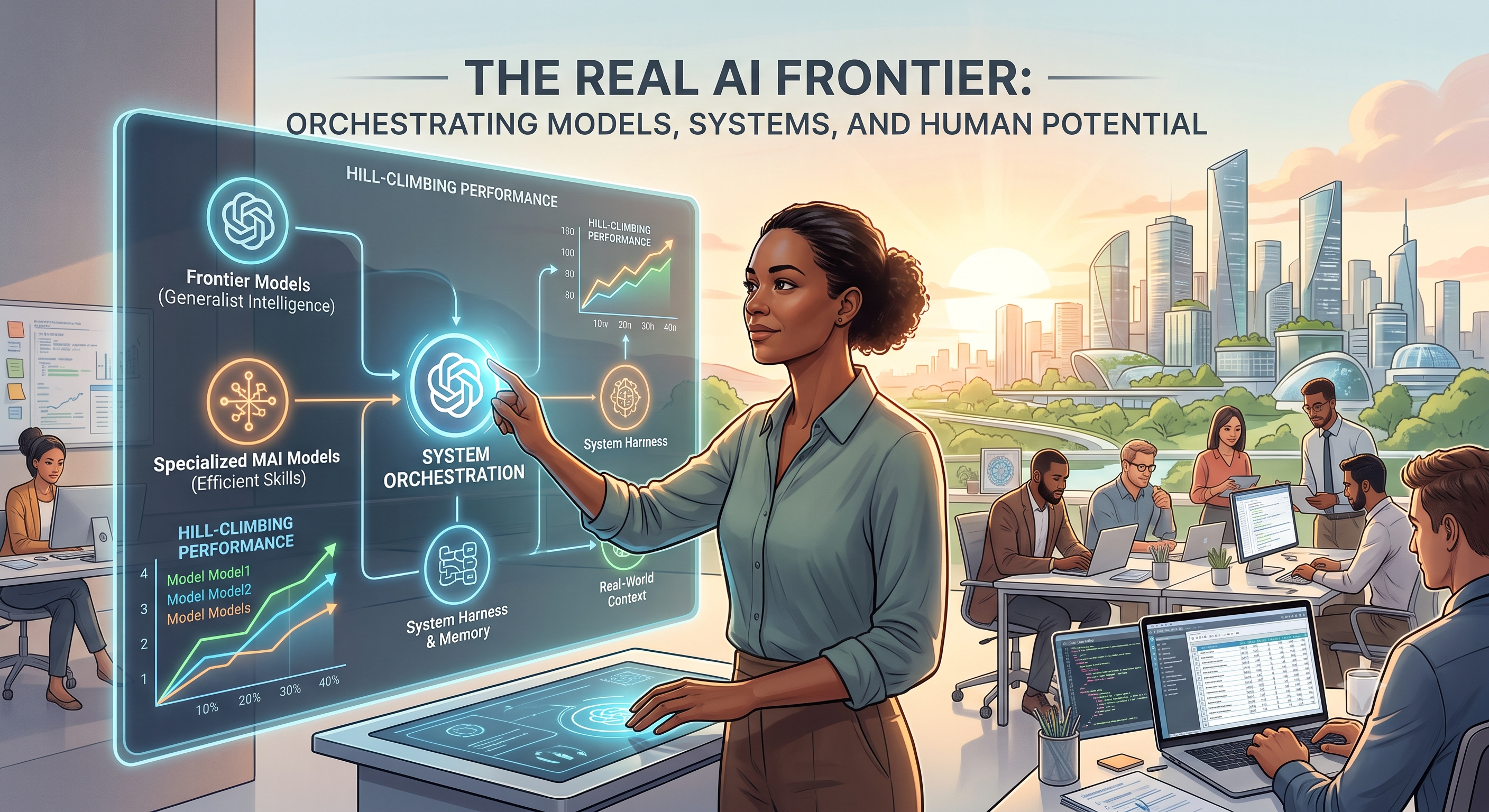
For years, software followed a familiar economic pattern: once it was built, the cost of serving one more user was close to zero. Generative AI changes that equation. Every prompt, document analysis, code suggestion, or agentic workflow consumes computing resources. Intelligence now has a measurable marginal cost. That may sound like a technical problem, but it points to a much larger opportunity. The goal is not to give every task the biggest, most powerful model available. The goal is to produce the best possible outcome for the time, money, energy, and attention invested. That means selecting the right model for the task, providing it with the right context, connecting it to the right tools, and placing it inside a system designed around the work people actually need to accomplish. But there is another layer that matters just as much. Even the best technical system will underperform when the people using it have not had the opportunity to rethink how they work, develop new habits, or understand where human judgment adds the most value. Optimizing AI without helping humans learn alongside it is like installing a more powerful engine without reconsidering how the vehicle should be driven. The next stage of AI adoption will therefore require two kinds of hill-climbing at the same time: improving the technology around the model and improving the human system around the work.
The model is only one part of the system
It is tempting to treat AI adoption as a model-selection exercise. Which model performs best? Which benchmark does it lead? Which provider has the largest context window or the strongest reasoning scores? Those questions matter, but they are not the whole story. In a real product or workplace, performance is shaped by far more than the model. It depends on the quality of the context, the available tools, the memory system, the instructions, the interface, the workflow, and the feedback the system receives. It also depends on whether the person using it knows how to frame the problem, review the output, and decide what should happen next. A smaller specialized model operating inside a well-designed system may outperform a more expensive general-purpose model. A carefully constructed workflow may require fewer tokens, fewer corrections, and less human effort. Meanwhile, frontier models can remain available for the genuinely frontier tasks that demand their broader capabilities. This is the logic behind model orchestration and specialized model families such as Microsoft’s MAI models. Instead of assuming that one model should handle everything, organizations can route work according to complexity, risk, cost, latency, and desired outcome. They can train and evaluate systems against the real environments in which the work happens—not just abstract benchmarks. In practice, that could mean using different approaches for drafting an email, analyzing a spreadsheet, writing production code, preparing a presentation, or resolving a complex customer issue. The right answer is contextual. The strategic question is no longer simply, “Which model is best?” It is, “Which combination of model, context, tools, workflow, and human judgment produces the best outcome?”
The real cost-to-outcome frontier includes people
Once we frame the challenge this way, something important becomes clear: the cost side of the equation includes more than compute. It includes the employee who has to correct a vague output. It includes the manager who receives a polished summary but cannot tell whether the underlying analysis is sound. It includes the team that saves ten minutes generating content but spends an additional hour reconciling inconsistencies. It also includes the opportunity cost of using AI only to make an outdated process slightly faster. That last point may be the most important. Many organizations begin by inserting AI into existing workflows. The meeting stays the same, but AI writes the notes. The report stays the same, but AI drafts the first version. The approval process stays the same, but AI fills in some of the fields. These uses can be helpful. They reduce friction and give people a practical way to build confidence. But they are only the beginning. The larger opportunity is to ask whether the workflow itself should change. Could a weekly report become a continuously updated decision system? Could an employee spend less time assembling information and more time interpreting it? Could a customer issue be resolved before it becomes a complaint? Could teams explore scenarios that were previously too time-consuming to model? Could a small business gain access to analytical or creative capabilities that once required a specialized department? These are not primarily prompting questions. They are questions of strategy, operating design, and leadership.
AI adoption starts with leadership behavior
As AI becomes embedded in tools such as Outlook, Excel, PowerPoint, GitHub Copilot, and workplace chat, using it will feel less like adopting a separate technology and more like learning a new way to work. That transition will not happen because leaders announce that AI is important. It will happen when leaders demonstrate thoughtful use themselves. Are they using AI to improve the quality of their thinking, or only to produce material faster? Are they showing their teams how they verify an answer, challenge an assumption, and refine a weak result? Are they creating room for experimentation, including experiments that do not immediately succeed? Are they rewarding people for improving a process, or only for maintaining the existing one more efficiently? Employees notice the gap between what leaders say and what leaders do. A leader who encourages experimentation but treats every imperfect result as a failure will slow adoption. A leader who asks employees to use AI but never changes their own habits sends a similar signal. Positive change begins with curiosity and example-setting. A manager might use AI to examine several interpretations of a difficult decision, then explain to the team which suggestions were useful and which were rejected. A finance leader might show how an AI-supported analysis revealed a question worth investigating, rather than presenting the system as an unquestionable source of truth. A project leader might invite the team to redesign a recurring workflow and measure whether the new approach improves quality, speed, or customer value. These behaviors make AI less mysterious. They also reinforce an essential principle: people remain responsible for defining the goal, evaluating the result, and making the decision.
Build systems that keep learning
One of the strongest technical principles in the emerging AI ecosystem is model independence. A durable product should not become incapable of improving because one particular model is removed or replaced. Its context, memory, tools, skills, and evaluation methods should exist outside any single model whenever possible. There is a valuable human parallel. An organization should not become dependent on a handful of “AI people” who know the secret prompts or have experimented more than everyone else. The learning should be externalized and shared. Useful examples can become team playbooks. Successful workflows can become reusable templates. Evaluation criteria can be documented. Lessons from failed experiments can be made visible. Employees can teach one another how to review outputs, protect sensitive information, identify uncertainty, and decide when human expertise must take the lead. This turns scattered experimentation into organizational capability. The same product-specific evaluations used to improve an AI system can also help improve the human system. Instead of measuring adoption by the number of prompts submitted or licenses activated, organizations can ask: Did this improve the customer outcome? Did it reduce unnecessary effort? Did it improve the quality or consistency of the decision? Did it help an employee learn something useful? Did it create more time for judgment, creativity, collaboration, or care? Would the workflow remain effective if the underlying model changed? These measures encourage teams to optimize for meaningful progress rather than visible activity.
The future of work is something we will shape
AI is moving quickly, but speed does not require fatalism. We are not passive observers waiting to discover what technology will do to work. We are active participants deciding how these systems will be designed, evaluated, taught, and used. The technical opportunity is significant. Specialized models, frontier models, better orchestration, richer context, stronger tools, and real-world learning environments can make advanced capabilities more affordable and widely available. The human opportunity is just as significant. We can remove repetitive friction while giving people more room to think. We can make expertise easier to access. We can help teams explore more possibilities before committing to a decision. We can redesign processes around outcomes rather than inherited routines. And we can build workplaces where learning how to work with AI becomes part of the work itself. The organizations that benefit most will not necessarily be those with access to the largest model. Access will increasingly be widespread. The advantage will belong to those that learn how to combine technology, workflow, leadership, and human judgment into a system that continually improves. So the most useful questions for leaders may be these: How are we examining the way work actually happens? Where are we simply adding AI to an old process, and where are we prepared to redesign the process? What behaviors are leaders modeling for their teams? How are we helping people develop judgment, not just prompting skills? And are we evaluating success based on how much AI we use—or on the outcomes we achieve together? The model matters. The surrounding system matters more. And the people who shape that system matter most.
Last Modification : 7/23/2026 11:47:24 PM
In This Document
Subscribe to the newsletter!
Get information about the latest happenings.
Platform
- Curriculum
- Blog
- FAQ